

Feeling overwhelmed by intense emotions? Struggling to navigate relationships or cope with distress? If so, you might be curious about dialectical behavior therapy (DBT), a powerful approach renowned for its effectiveness in treating a variety of mental health challenges. Here’s how you can find what are the six main points of dialectical behavior therapy?
But what exactly is DBT? And what are the six main points of dialectical behavior therapy that form its foundation? Let’s unravel these pillars guiding individuals toward a more balanced and fulfilling life.
Is your emotional intensity affecting your daily life?
When emotions dictate your actions, DBT offers proven techniques to help you regain balance and take charge of your emotional well-being.
Emotional stability starts from here!
866.939.6292
The six main points of Dialectical Behavior Therapy
DBT, or dialectical behavioral therapy, is a form of talking therapy designed to address intense emotions, often performed through one-on-one sessions with therapists, group therapy, or phone coaching.
Dialectical Behavior Therapy (DBT) comprises six main points or components, each designed to address different aspects of mental health and well-being. These components work together to provide individuals with comprehensive skills to navigate life’s challenges. Here are the six main points of DBT:
Mindfulness:
- Foundational skill for being fully present in the current moment without judgment.
- Involves observing and describing experiences, cultivating awareness, and active participation in one’s life.
Distress Tolerance
- Equips individuals to endure and survive unavoidable distressing situations.
- Teaches skills to prevent impulsive or harmful behaviors during crises.
- Emphasises acceptance of the current situation and finding healthy ways to cope with emotional pain.
Emotion Regulation
- Focuses on understanding and managing emotions for mental well-being.
- Helps individuals identify and label emotions.
- Teaches the functions of different emotions and strategies to modulate intense feelings.
- Aims to foster emotional stability.
Interpersonal Effectiveness
- Vital for building and maintaining healthy relationships.
- Teaches assertive communication, setting boundaries, and navigating social interactions.
- Aims to improve relationship quality and reduce interpersonal conflicts.
Middle Path
- Central to DBT, encourages finding a balance between acceptance and change.
- Emphasizes acknowledging the validity of opposing viewpoints.
- Promotes working towards a synthesis that fosters growth and positive transformation.
Skills Training
- Recognizes that theory alone is insufficient; practical application is crucial for lasting change.
- Involves regular practice of skills learned in mindfulness, distress tolerance, emotion regulation, and interpersonal effectiveness.
- Ensures individuals can effectively apply these skills in their daily lives.
Together, these six main points form a comprehensive framework addressing the multifaceted nature of mental health challenges. They provide individuals with a roadmap for personal growth, emotional well-being, and improved interpersonal relationships.
Fascinating Facts about Dialectical Behavior Therapy (DBT) Components:
Mindfulness
- Developed by a Buddhist monk, Thich Nhat Hanh, in the 1970s.
- Can change the structure of your brain, increasing grey matter in areas associated with emotional regulation and attention.
- Studies show it’s as effective as antidepressants for treating depression.
Distress Tolerance
- Radical acceptance isn’t about giving up, it’s about acknowledging reality and choosing how to respond.
- Imagine it like surfing a wave: you don’t resist it, you learn to ride it skillfully.
- “Wise mind” skills like observing and describing emotions objectively help you manage distress without getting overwhelmed.
Emotion Regulation
- Identifying your emotional triggers is like being a detective, figuring out what sets you off.
- DBT teaches you to “label” your emotions accurately, like naming a color instead of just saying “bad feeling.”
- There are even “opposite action” techniques, where you do the opposite of what your emotions urge you to do, to break unhealthy patterns.
Interpersonal Effectiveness
- DBT isn’t about being aggressive or passive, it’s about finding the “assertive middle.”
- You learn to express your needs and wants clearly while respecting others’ boundaries.
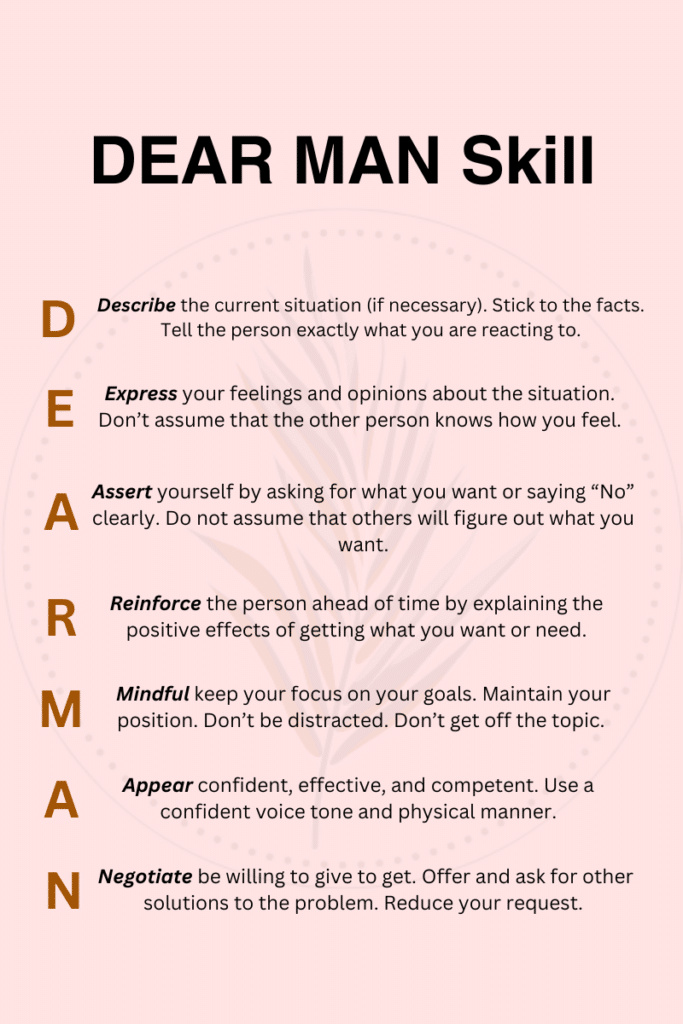
- “DEARMAN” skills help you navigate conflict with confidence: Describe, Express, Ask, Reinforce, Mindful, Appear confident, Negotiate.
Acceptance and Change
- This is the core paradox of DBT: accepting things as they are while also striving for positive change.
- It’s like holding a delicate flower: you appreciate its beauty while gently guiding it towards the sunlight.
- This balance empowers you to rewrite your narrative and embrace challenges as opportunities for growth.
Building a Life Worth Living
- DBT goes beyond symptom management, it helps you discover your values and purpose.
- It’s like painting your masterpiece, using the skills you learn to create a life filled with meaning and joy.
- Dialectics, the core philosophy of DBT, reminds you that life is full of contradictions, and finding meaning lies in navigating them with wisdom and grace.
Remember, these fascinating facts merely scratch the surface! DBT holds a wealth of tools and insights waiting to be uncovered. Take the plunge, delve deeper, and unveil the potential for a serene and more gratifying life.
Demystifying the 24-Hour Rule: A DBT Tool for Emotional Regulation
Ever wondered how to deal with overwhelming emotions? Enter the 24-hour rule in Dialectical Behavior Therapy (DBT). Dialectical behavior therapy (DBT) offers a powerful tool called the 24-hour rule, a simple yet profound technique to regain control and navigate challenging situations with greater clarity.
What is the 24-hour rule?
Imagine you’re in a situation that triggers a big emotional response. The 24-hour rule acts like a pause button, urging you to step back from the immediate storm and wait 24 hours before reacting. This intentional delay allows the emotional intensity to simmer down, giving space for your rational mind to emerge and assess the situation objectively.
Why wait 24 hours?
Our brains are wired for survival. When triggered, we often react instinctively, fueled by fear, anger, or sadness. The 24-hour rule disrupts this automatic pattern. By consciously creating a delay, we give ourselves the opportunity to:
- Gain perspective: Emotions act like color filters, distorting reality. The 24-hour rule allows the filter to fade, revealing the situation in its true colors.
- Identify triggers: What sparked this intense reaction? Recognizing your emotional triggers empowers you to avoid them in the future or develop coping mechanisms beforehand.
- Develop distress tolerance: Waiting 24 hours is an exercise in emotional resilience. It teaches you to ride the waves of emotion without getting swept away.
- Make mindful choices: With a calmer mind, you can choose your response instead of letting your emotions dictate it. You can communicate assertively, set boundaries, or simply choose to disengage.
Taking control of your emotions starts with small steps, and the 24-hour rule can be your first empowering stride. So, breathe deeply, hit pause, and allow yourself the space to respond instead of react. Your emotional well-being and a calmer, more fulfilling life await.
Finding a DBT Specialist
Now, let’s talk about finding a therapist trained in Dialectical Behavior Therapy. DBT isn’t something everyone learns in regular therapy training. So, when searching for a DBT specialist, utilize resources like the Psychology Today website, where professionals with DBT training are listed. Seek recommendations from friends or family and schedule consultations to ensure the therapist aligns with the six main points of Dialectical Behaviour Therapy. Remember, finding the right therapist is like discovering the perfect puzzle piece for your journey toward success with DBT.
Where to find your DBT guide:
- Psychology Today: This website allows you to filter therapists by specialty, including DBT.
- Local DBT centers: Many communities offer DBT programs with access to therapists specifically trained in this modality.
- Word-of-mouth recommendations: Ask friends, family, or healthcare providers for referrals.
Remember, the right therapist can make all the difference in your DBT journey. Schedule consultations, ask questions, and find someone you feel comfortable and confident with.
Your Journey to a Brighter Tomorrow
At Calusa Recovery, we empower you to overcome addiction and mental health challenges with personalized treatments that help you reclaim a healthier, fulfilling life
Help Me Transform My Life
Can I Do DBT on My Own?
While working with a trained therapist is the gold standard for learning and practicing Dialectical Behavior Therapy (DBT), sometimes circumstances call for a personal approach. If you’re considering tackling the six main points of DBT (mindfulness, distress tolerance, emotion regulation, interpersonal effectiveness, acceptance and change, and building a life worth living) on your own, here’s what you need to know about the dialectical behavior therapy components and whether you can truly go solo:
Yes, resources are available. Books, online courses, and DBT self-help groups can provide valuable self-guided learning opportunities. You’ll gain insights into the core concepts, learn practical skills, and connect with others on a similar path.
But, keep in mind, DBT is a bit like a complex puzzle – having a guide (a trained therapist) can make the journey smoother. A therapist offers support and keeps you on track as you learn and use DBT skills. They’re like the GPS on your road trip to emotional well-being.
Here’s why a therapist acts as your DBT GPS:
- Personalized roadmap: Therapists tailor DBT to your specific goals and struggles, ensuring you focus on the most relevant skills first.
- Support and accountability: They’re your cheerleader, motivator, and confidant, holding you accountable when progress gets tough.
- Troubleshooting: They help you identify and overcome roadblocks, adjust your approach as needed, and fine-tune your skills for maximum impact.
- Emotional safety net: Therapy provides a safe space to explore your vulnerabilities and practice skills without fear of judgment.
The Bottom Line:
In concluding our exploration of the six main points of Dialectical Behavior Therapy (DBT), it becomes evident that this therapeutic approach is not merely a set of principles but a profound journey toward personal transformation. The core components – mindfulness, distress tolerance, emotion regulation, interpersonal effectiveness, finding the middle path, and skills training – form a holistic framework aimed at addressing the multifaceted challenges of mental health.
DBT serves as a compass guiding individuals through the intricate landscape of their thoughts, emotions, and behaviors. The emphasis on mindfulness lays the foundation for self-awareness and active participation in the present moment, while distress tolerance equips individuals to navigate crises with resilience. Emotion regulation emerges as a key to fostering stability and understanding the intricacies of one’s emotional landscape.
As we wrap up this exploration of DBT’s core components, we invite you to reflect on your journey. How do these principles resonate with your experiences? Have you found resonance with mindfulness, strength in distress tolerance, or newfound stability through emotion regulation?
Share your thoughts, and let’s continue this conversation on the transformative power of Dialectical Behavior Therapy.